







When Genetics Says “Limit,” Leave Room for Possibility
When Genetics Says “Limit,” Leave Room for Possibility
Details
Written by Michelle Davies
Published: 18 August 2026
Created: 18 August 2026
Last Updated: 18 August 2026
The more I understand about the human body, the more I find myself in awe of it.
And for me, this magnificence points to God.
Our bodies contain trillions of cells. Inside the nucleus of most of those cells are 46 chromosomes - 23 pairs, half inherited from our mother and half from our father.
Those chromosomes contain our DNA.
Unravel the DNA from just one cell and it would stretch approximately two metres.
And within our DNA are thousands of genes carrying the biological instructions that help our cells develop, communicate, function and repair.
Yet here is something I believe we often misunderstand:
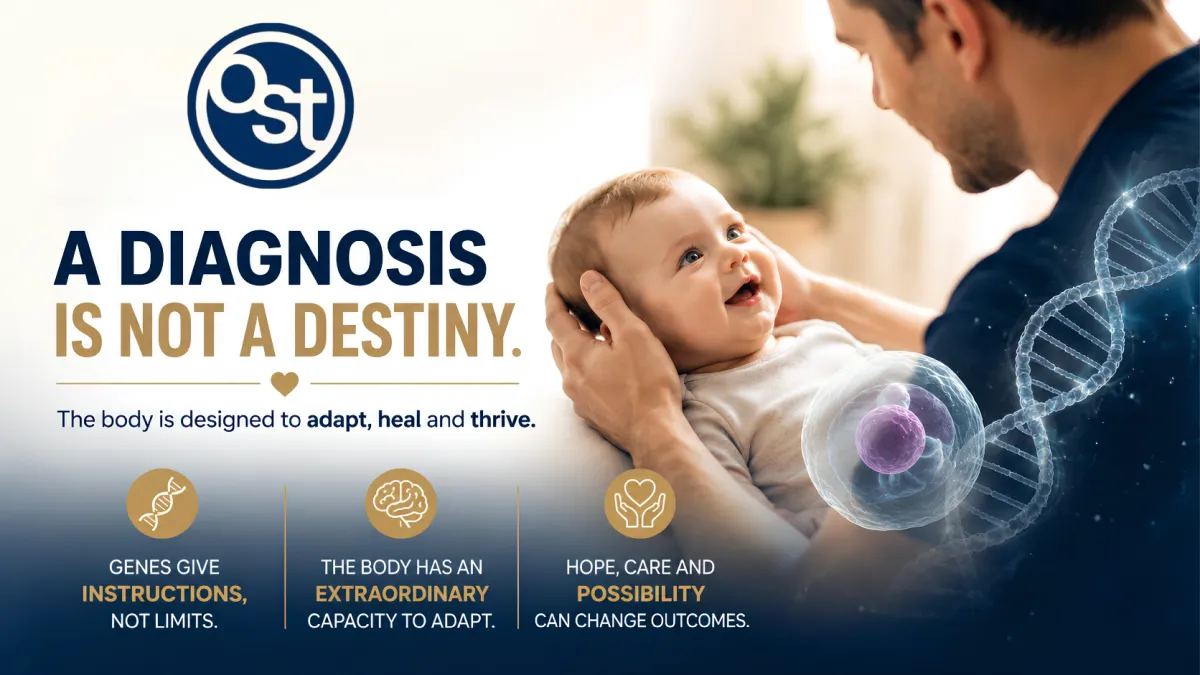
OUR GENES ARE IMPORTANT, BUT THEY ARE NOT ALWAYS OUR DESTINY
I have worked with many children with rare genetic and chromosomal conditions.
Sometimes their parents arrive having been given a devastating list of everything their child may never do.
Recently, a mother brought her young baby boy to see me.
She was incredibly distressed.
Because of his condition, his parents had been prepared for a long list of potential developmental problems, including the possibility that their baby would be blind.
I worked gently with his head and brain, particularly around the areas behind his eyes, with my focus on reducing the restrictions I found and supporting fluid movement and the glymphatic system.
Then something happened that I will never forget.
HE LOOKED AT ME.
And smiled.
He wasn’t looking somewhere in my direction.
He engaged with me.
I remember thinking:
He can see me.
After further treatments, his eyesight was assessed.
His eyesight was fine.
His genetic condition hadn’t disappeared.
His chromosomes hadn’t suddenly changed.
But the outcome his parents had been prepared for was not the outcome they were now witnessing.
SO WHAT DOES THAT TEACH US?
A chromosome is not a prophecy.
Our genes provide biological instructions, but those instructions operate within a living, changing human being.
The developing brain has an extraordinary capacity for adaptation.
Our cells exist within an environment influenced by oxygen, circulation, nutrition, hormones, inflammation, movement, sensory experiences, relationships, and countless biochemical signals.
And gene expression itself is dynamic. Having a particular gene does not mean every gene is being expressed identically in every cell at every moment.
This is why I am interested not only in what diagnosis a child has, but also in:
What can we change around it?
What restrictions can we address?
What aspects of function can we support?
What potential has not yet been realised?
TWO METRES OF DNA. INSIDE ONE MICROSCOPIC CELL.
Think about that for a moment.
The chromosomes containing that DNA are copied again and again throughout our bodies as cells divide.
At the same time, cells are communicating.
Electrical gradients are being maintained.
Mitochondria are producing energy.
Proteins are being built.
DNA is being read and repaired.
The brain is adapting.
The body is constantly responding to its environment.
Much of this happens without a single conscious instruction from us.
Science gives us extraordinary insight into how many of these processes happen.
My faith gives me my answer to something different:
Who created such magnificence?
For me, that answer is God.
“I praise you because I am fearfully and wonderfully made.” - Psalm 139:14
I don’t believe a diagnosis should ever be ignored.
But neither do I believe we should automatically mistake a diagnosis for the absolute limit of what a child may become.
Sometimes we need to leave room for the extraordinary capacity of the human body.
Sometimes we need to leave room for possibility.
And sometimes a tiny baby simply looks you directly in the eyes…
and smiles.