


















The Breath-Brain Connection: How Every Breath Creates Movement Inside You
The Breath-Brain Connection: How Every Breath Creates Movement Inside You
Details
Written by Michelle Davies
Published: 6 October 2026
Created: 6 October 2026
Last Updated: 6 October 2026
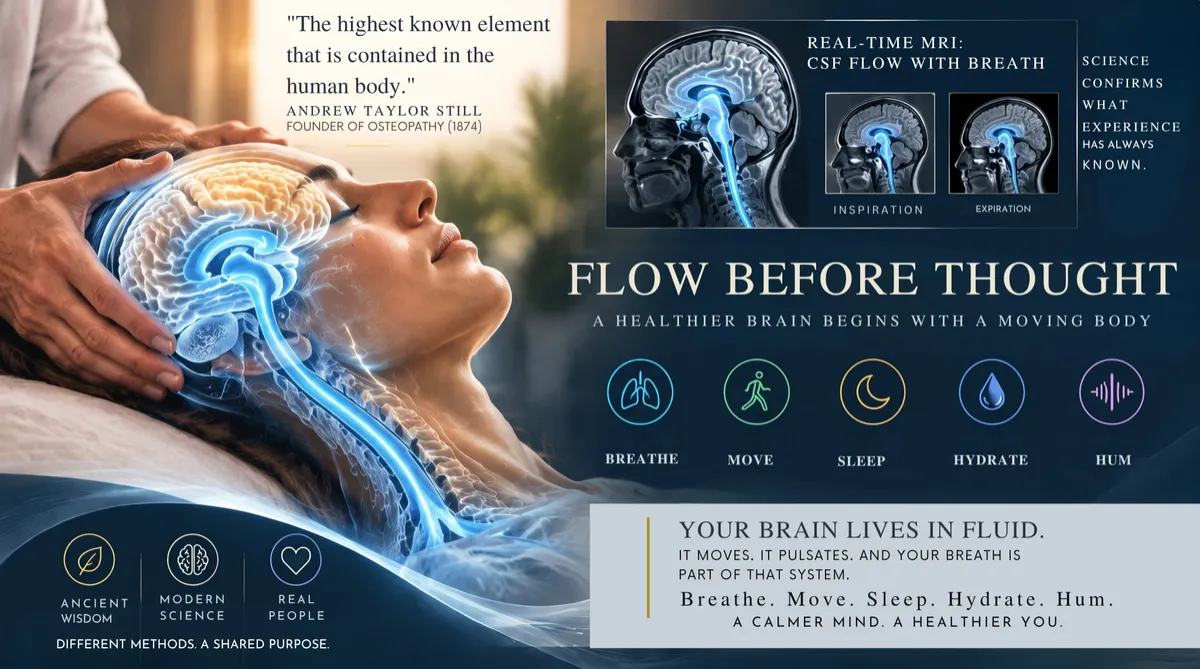
I came across a post this week about scientists using real-time MRI to watch cerebrospinal fluid CSF move with the breath.
It caught my attention.
But not because this was new to me.
Quite the opposite.
I was taught to feel this nearly 30 years ago.
During my osteopathic training, I was taught to use my hands to feel the subtle movements of the cranial mechanism and cerebrospinal fluid.
And then I spent decades doing it.
Thousands upon thousands of hours with my hands on people’s bodies and heads, developing the sensitivity to feel movement, restriction and change - and using my hands to influence that movement.
So when I see modern research showing CSF moving in response to breathing, I find it fascinating.
Not revolutionary.
Because flow has always been fundamental to osteopathy.
Andrew Taylor Still founded osteopathy in 1874. His philosophy placed enormous importance on the movement of fluids through the body. He later described cerebrospinal fluid as:
“the highest known element that is contained in the human body.”
More than a century later, researchers began using increasingly sophisticated real-time MRI techniques to actually watch CSF moving inside living human beings.
A 2015 study demonstrated that breathing was a significant driver of CSF movement. Further studies mapped respiratory-driven CSF movement through the spinal canal and investigated differences during chest and abdominal breathing.
Amazing technology.
But there’s something wonderfully simple about all this.
Your brain lives in fluid.
It isn’t an isolated organ sitting motionless inside your skull.
Its environment is dynamic.
It moves.
It pulsates.
And your breathing is part of that system.
This is why my work has never started simply with someone’s thoughts or symptoms.
I want to know:
How is the system moving?
What can I feel beneath my hands?
Where is there freedom?
Where do I feel restriction?
And what happens to the person when I work to restore movement?
Modern MRI can objectively measure aspects of CSF dynamics. My hands are the clinical tool I was trained to use. They are different methods, and science has not established manual palpation as an MRI-equivalent measurement of CSF flow.
But after nearly 30 years of doing this work, I know what I feel beneath my hands and I have become highly skilled in working with it.
And there’s another part you can influence yourself.
Your breath.
This is one reason my 5-minute hum matters to me.
Slow nasal breathing followed by a long, comfortable hum naturally changes your breathing pattern and extends your exhalation. Humming has also been shown experimentally to produce a large increase in nasal nitric oxide compared with quiet exhalation.
So perhaps brain care doesn’t always have to be complicated.
Breathe.
Move.
Sleep.
Hydrate.
And hum.
Because before we obsess about changing every thought inside our heads, perhaps we should pay more attention to the physical environment in which those thoughts are being produced.
I’ve said it before, and I’ll keep saying it:
FLOW BEFORE THOUGHT.
Flow. Frequency. Focus.
Michelle
Research: Dreha-Kulaczewski et al., Journal of Neuroscience (2015); Scientific Reports (2018); Aktas et al., Fluids and Barriers of the CNS (2019).