
















The Silent Link Between Jaw Tension, Brain Fog, and Emotional Overwhelm
The Silent Link Between Jaw Tension, Brain Fog, and Emotional Overwhelm
Details
Written by Michelle Davies
Published: 05 June 2025
Created: 05 June 2025
Last Updated: 05 June 2025
Most people think stress lives in the mind.
But after nearly three decades working hands-on with the nervous system, brain function, and cranial mechanics…
I’ve found something fascinating.
Many people are unknowingly holding enormous amounts of neurological tension in one specific area:
The jaw.
Not just emotionally.
Mechanically. Neurologically. Structurally.
And it may be affecting far more than people realise.
I often see patients with:
chronic anxiety
brain fog
headaches
jaw clenching
poor sleep
neck tension
emotional overwhelm
sensory sensitivity
nervous system dysregulation
…who are unknowingly living in a constant state of subtle bracing.
Their nervous system never fully “lets go”.
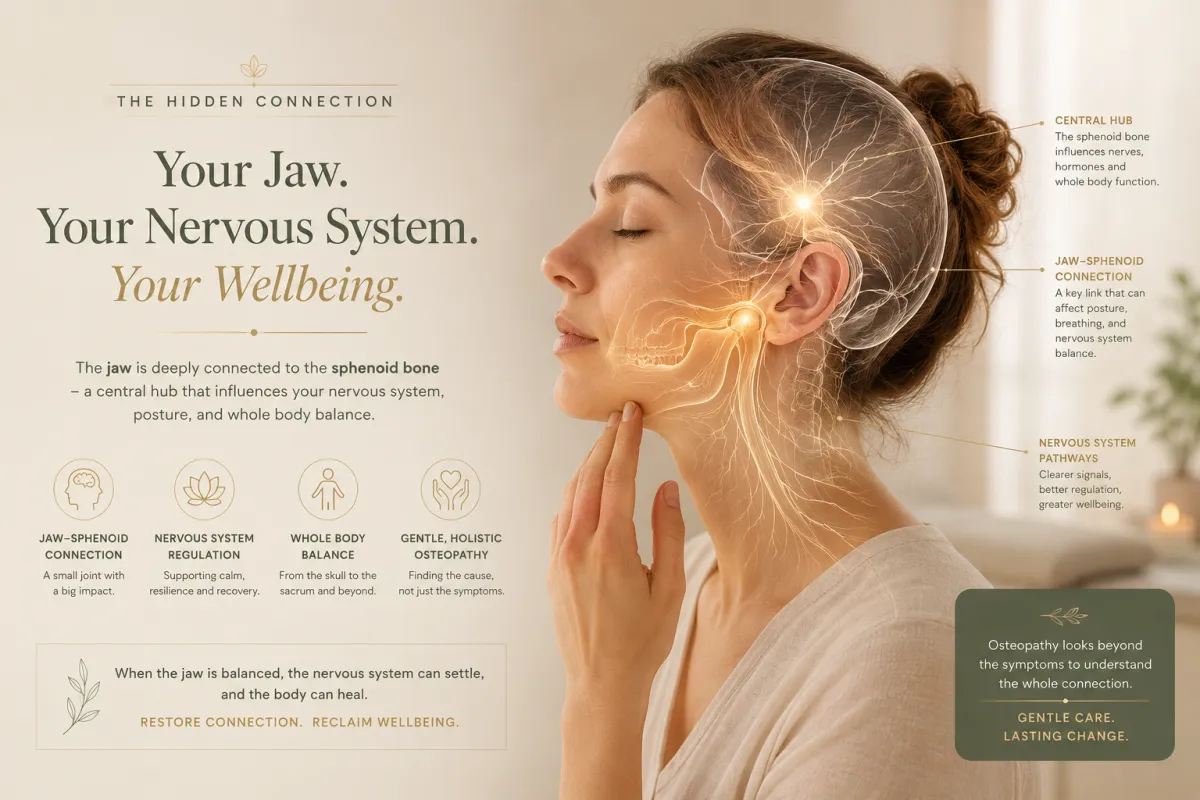
One of the areas I frequently assess is the relationship between the jaw and the sphenoid bone.
The sphenoid sits deep within the centre of the skull and connects with multiple cranial bones. It also has close relationships with the jaw, temporals, eyes, cranial nerves, membranes, and the surrounding neurological structures.
When tension patterns build around this area, the body can remain stuck in a protective state.
This is why some people:
wake exhausted despite sleeping
feel constantly “wired”
struggle to switch off
clench their jaw without noticing
experience pressure around the eyes or temples
feel emotionally reactive for no obvious reason
One of the simple exercises I sometimes prescribe involves rhythmic tongue stimulation against the roof of the mouth.
It sounds incredibly simple.
But the tongue has powerful neurological and fascial connections into:
the jaw
cranial base
throat
vagus nerve pathways
deep neck muscles
sphenoid region
When performed correctly, this exercise can help soften chronic jaw bracing patterns and encourage the nervous system into a calmer, more regulated state.
Patients often report:
a quieter mind
reduced jaw tension
improved breathing
emotional settling
deeper relaxation
less neck tightness
improved clarity
This is not about “hacks”.
It’s about understanding how structure influences function.
The body is always communicating.
And sometimes the very area holding tension is the same area influencing how safe your brain feels.
I’ve recorded a short demonstration video showing the exercise and explaining why it may help regulate the nervous system and release jaw–sphenoid tension.
Click this link to watch the video
Michelle Davies
Brain Care Expert
Harley Street, London
Bromyard Herefordshire